
The advertising industry doesn’t sit still for long. Budgets shift, platforms evolve, measurement standards change, and what worked last year doesn’t always hold up today.
And yet, through all that movement, one channel keeps gaining ground: connected TV.
Streaming viewership continues to grow. Ad-supported models are expanding. Targeting and measurement capabilities are improving. What was once considered experimental is now showing up as a priority line item in more and more media plans.
This is our ongoing look at the connected TV trends shaping that shift. We’ll update it quarterly with the latest CTV advertising news, new industry data, and practical takeaways for marketers deciding where their next dollar should go.
Q2 2026 Updates
1. Streaming has become audience’s most engaging channel
Streaming has officially moved beyond convenience and into something deeper: high-attention, high-engagement viewing.
According to the latest Harris Poll research:
- 90% of viewers say on-demand streaming is more engaging than scheduled TV
- 90% also say it’s more engaging than social media
- Nearly half of viewers are now watching 3.5+ hours in a single sitting (up from just 9% last year)
- 75% say co-viewing makes streaming feel like quality time
On top of that, more than half of viewers prefer watching on the biggest screen in the home, reinforcing what makes CTV so powerful for advertisers.
2. Time spent has officially tipped in CTV’s favor (and it’s accelerating)
We’re now seeing the long-anticipated shift fully materialize: CTV is overtaking traditional TV in time spent.
- CTV will surpass linear TV in daily viewing time in 2026
- By 2027, the gap will approach an hour per day
- Nearly 120 million US households will be using CTV this year
- Cord-cutters will make up more than half of US households by 2027
At the same time, ad dollars are following:
- Linear TV ad spend is projected to decline
- Digital TV (CTV + streaming) is expected to grow to $21B+
Audiences have already shifted, and budgets are finally catching up.
3. Live events are proving the power of attention at scale
Major sports events & programming moments continue to show why TV plays a critical role in the media mix, especially when paired with CTV. Take eMarketer’s findings around March Madness:
- $499M in ad spend during opening weekend (+5% YoY)
- 14.5 billion impressions across just a few days
- Ads performed 19% better than the industry average in attention
- Viewership increased 7% YoY
Live events are still one of the most powerful ways to capture mass attention quickly. When combined with always-on CTV campaigns, they create both immediate impact and sustained performance.
4. Vertical video is becoming a discovery layer for TV, not just social
One of the more unexpected shifts this year: vertical video is moving into streaming environments.
Platforms are now experimenting with TikTok-style feeds inside their apps, surfacing short clips to help users discover longer content, increase engagement and drive deeper viewing sessions.
However, marketers are still seeing a gap in effectiveness: while 31.2% rate CTV as “very effective”, just 12.8% give the same ratings to vertical video.
The takeaway? Vertical video isn’t replacing CTV, it’s becoming the entry point into it. The smartest marketers are using it as a way to spark interest, then driving deeper engagement on the TV screen.
Q1 2026 Updates
1. Streaming Now Accounts for Nearly Half of TV Viewing
One of the clearest connected TV trends is simply this: streaming now represents a massive share of total TV time.
According to Nielsen’s December 2025 The Gauge report, streaming accounted for 47.5% of total U.S. television viewing time, marking the highest share recorded to date. Earlier in 2025, Nielsen reported streaming at 43.8% of total TV time, reflecting a steady upward trend over the past two years.
For advertisers watching broader advertising trends, this shift is not incremental. It represents a structural change in where large-screen attention lives.
2. CTV Adoption Is Near Universal
It’s official: almost every single American is streaming these days.
Adwave projects that more than 90% of U.S. households use connected TV devices, including smart TVs, streaming sticks, and gaming consoles. And AIDigital similarly reports that connected TV device penetration has reached roughly nine in 10 households, confirming widespread adoption.
For marketers, this means CTV offers both national scale and household-level targeting in the same channel. Whoever your target audience is, they’re reachable on CTV.
3. Streaming Is the Default Viewing Behavior
Consumer preference is also shifting in a measurable way.
Roughly 70% of U.S. adults now turn to streaming first when watching video content, rather than traditional cable or broadcast.
That preference matters. It signals that streaming is no longer a secondary behavior. It is the starting point.
For advertisers, this means campaigns built around connected TV align with how audiences are choosing to watch, not interrupting an older viewing habit.
4. Ad-Supported Streaming Continues to Expand
Another important connected TV trend is the growth of ad-supported streaming models.
Free Ad-Supported Streaming TV services now reach approximately 60% of U.S. households, indicating that FAST platforms have moved into the mainstream.
At the same time, many subscription services have seen growth in ad-supported tiers as consumers balance cost and content access.
For marketers, this expansion increases available inventory while maintaining viewer receptivity to ads. It also reflects a broader shift in advertising trends where premium content and advertising coexist by design.
5. Attention and Engagement Are Moving to the Big Screen
As measurement evolves, attention is becoming a more important metric across media buying.
Connected TV offers structural advantages in this area:
- Full-screen ad delivery
- Limited multitasking compared to mobile environments
- Lean-back viewing sessions
eMarketer’s Industry KPI data shows that engagement per impression on interactive CTV ads reached 1.94% in Q2 2025, up from 1% in Q2 2024. Engagement per impression measures when viewers actively use their remote to interact with an ad, indicating deliberate engagement rather than passive exposure.
This development is notable in ongoing CTV advertising news because it demonstrates that streaming can support both awareness and measurable interaction.
6. Premium Environments Are Driving Trust
Media context continues to matter. According to The Trade Desk’s 2025 Premium Payoff Report:
- Premium media environments drive a 40% increase in purchase intent
- They are 30% more effective than less premium environments
- 85% of respondents say premium environments increase trust in advertisers
As brand safety and trust remain top concerns across advertising trends, connected TV’s professionally produced environments provide a consistent, controlled setting for campaigns.
7. CTV Is Strengthening Cross-Channel Performance
Connected TV is increasingly being used alongside search and social rather than in place of them.
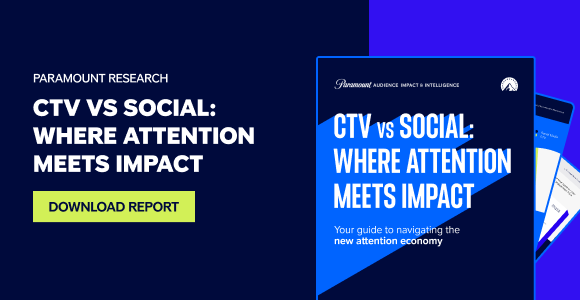
Research from our CTV vs Social report shows:
- Paid search conversion rates increase by 22.3% when supported by CTV exposure
- Paid social conversion rates improve by 8.5% when audiences have previously seen a brand on streaming TV
- 51% of heavy CTV viewers search online after seeing something on TV
This reinforces one of the more practical connected TV trends: CTV works best as part of a coordinated media strategy.
If you want to explore the full data behind these findings, you can download the CTV vs Social Report here.
Why These Connected TV Trends Matter
Streaming share continues to climb. Ad-supported viewing continues to expand. Adoption remains near universal. Measurement capabilities continue to improve.
For marketers building plans in 2026 and beyond, connected TV is not a fringe channel. It is a core part of the modern media mix.
Bookmark this page and check back each month as we continue adding the latest connected TV trends, CTV advertising news, and industry data.
LATEST INSIGHTS

RECOMMENDED




LANDMAN | PARAMOUNT+